|
|
Prises
de position - |
|
|
Prises
de position - |
Tunisia
In Gabès, capitalism is poisoning the population
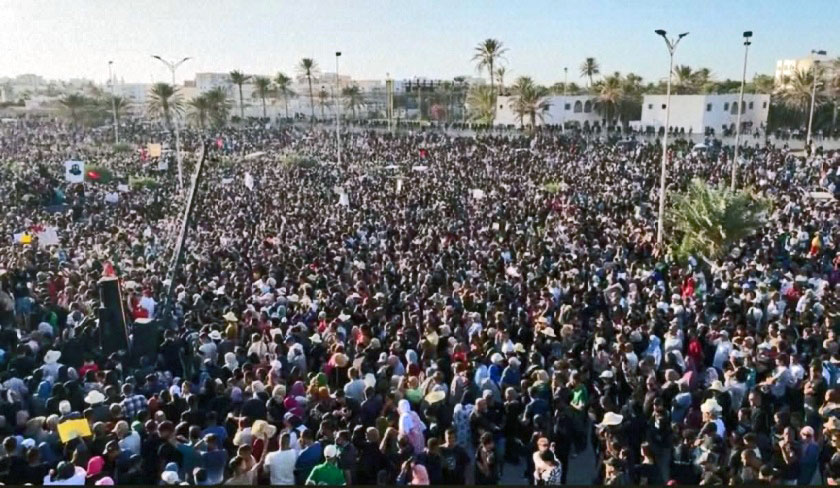
Since the beginning of October, the city of Gabès in southern Tunisia has been the scene of demonstrations and riots against the pollution caused by the industrial complex of the Tunisian Chemical Group (GCT), to which the government responded with more than a hundred arrests. Despite this repression, on 21 October tens of thousands of people demonstrated in the city (the largest protest ever seen in Tunisia), where a general strike was widely followed, and other demonstrations soon followed.
What triggered the population’s anger was the number of people hospitalized in early September for respiratory disorders (more than 300), including schoolchildren, following toxic gas emissions released by the GCT factories. This is, in fact, a real case of chemical poisoning that the inhabitants of the region have been denouncing for a long time.
The industrial complex was established on the Mediterranean coast, in Gabès, in the early 1970s to process the phosphate extracted from the Gafsa mines into phosphoric acid and agricultural fertilizers intended for export. The poisoning of the air and water over the years has been the result of the activity of these highly polluting factories, which discharge their waste into the sea, onto the land, and into the atmosphere.
 Once
rich in fish and a reserve of marine biodiversity, the Gulf of Gabès has
become the “cemetery of the Mediterranean”: it has not withstood the dumping
— without any treatment — of more than 500 million tons of phosphogypsum
since 1972. A by-product of ore processing with sulfuric acid in fertilizer
production, phosphogypsum releases various toxic elements, acidifies
seawater, emits radon gas, and contains radioactive materials. Today some
surrounding beaches show radiation levels three to four times higher than
the internationally recommended limit. The untreated discharge of
phosphogypsum and other solid, liquid, and gaseous industrial waste has also
devastated the environment of this coastal oasis, where 90% of the palm
groves have been destroyed. It has had serious consequences for the health
of workers and residents: premature deaths from cancer and cardiovascular
diseases, chronic respiratory illnesses, fluorosis, congenital malformations
in newborns, etc. (1).
Once
rich in fish and a reserve of marine biodiversity, the Gulf of Gabès has
become the “cemetery of the Mediterranean”: it has not withstood the dumping
— without any treatment — of more than 500 million tons of phosphogypsum
since 1972. A by-product of ore processing with sulfuric acid in fertilizer
production, phosphogypsum releases various toxic elements, acidifies
seawater, emits radon gas, and contains radioactive materials. Today some
surrounding beaches show radiation levels three to four times higher than
the internationally recommended limit. The untreated discharge of
phosphogypsum and other solid, liquid, and gaseous industrial waste has also
devastated the environment of this coastal oasis, where 90% of the palm
groves have been destroyed. It has had serious consequences for the health
of workers and residents: premature deaths from cancer and cardiovascular
diseases, chronic respiratory illnesses, fluorosis, congenital malformations
in newborns, etc. (1).
After the fall of Ben Ali, protests against the pollution caused by the GCT intensified. In 2013, after the site was blocked, the company agreed to stop dumping into the sea — something it never actually did — while the Ennahda government used employment blackmail (with 4,000 employees, the GCT is the largest employer in a region where unemployment reaches 25%) to defend the enterprise. Mobilization resumed in 2017, now demanding not a reduction in pollution but the closure of the site. On 27 June 2017, an agreement was finally signed for the gradual dismantling of the Gabès site over eight years; the eight-year period has passed, and not only has nothing been done, but the increasing deterioration of the installations has further increased pollution through multiple gas leaks.
Faced with the outrage caused by the poisoning of schoolchildren, President Kaïs Saïed declared in a speech in early September that a crime against the health of the population had been committed for 50 years, and he promised to act so that the inhabitants could breathe clean air.
But he forgot to mention that his government decided in March of this year to remove phosphogypsum from the list of hazardous products, while also planning to quintuple phosphate production due to its key role in economic growth, and to install an ammonia production plant in Gabès to supply the GCT, as part of a major “green hydrogen” production project aimed at Europe and carried out by the GCT, supported by Total and other large European corporations (2). Far from the promised dismantling of the site, this is in fact an expansion!
Whatever the government — dictatorial or democratic, Islamic or secular — it obeys the laws of capitalism, as the young activists of Gabès, who apparently supported Kaïs Saïed believing his promises, have discovered (3). Seeking to persuade the authorities, environmentalists have carried out complex calculations to estimate the operating losses suffered by fishermen, farmers, the tourism industry, and the losses caused to the economy by premature deaths and illnesses resulting from the pollution caused by the GCT. But such losses do not enter the capitalist productive cycle of the company, while expenditures for safety systems, sanitation, decontamination, or relocating polluting installations would lead to a corresponding reduction in profit. For capitalism, this is what matters — not the disastrous consequences for workers and the population, as long as they do not hinder the continuation of production. As Marx writes, in its development capitalism “exhausts at the same time the two sources from which all wealth flows: the earth and the worker” (4).
In Gabès, it is capitalism that is poisoning — and it is capitalism that must be fought.
(1) https://www.get.omp.eu/2024/12/la-mousse-de-phosphogypse-un-vecteur-de-pollution-industrielle-affectant-la-biodiversite-mediterraneenne-et-la-sante-des-populations-cotieres-de-gabes-se-de-la-tunisie/
(2) The production of ‘green hydrogen’ consumes large amounts of water, which would be an additional problem in the Gabès region, where the GCT's activities have significantly reduced the amount of water available. Total is partnered with an Austrian public company, and the project is expected to be financed by loans from various European banks. https://www.leconomistemaghrebin.com/2025/03/23/tunisie-vers-la-creation-hydrogene-vert/
(3) https://mondafrique.com/politique/la-ville-de-gabes-dans-le-sud-tunisien-suffoque-et-se-souleve/
(4) Karl Marx, Capital, Vol I, “The Development of Capitalist Production,” Section 4, Chapter 15.
November 28, 2025
International Communist Party
Il comunista - le prolétaire - el proletario - proletarian - programme communiste - el programa comunista - Communist Program
www.pcint.org
Top

