|
|
Prises
de position - |
|
|
Prises
de position - |
The Protests in Bolivia and the Need for an Independent Class Struggle
For several weeks now, Bolivia has been facing a wave of protests, demonstrations, and roadblocks. The capital, La Paz, has been virtually paralyzed by the roadblocks, which for more than four weeks have caused shortages of basic necessities and brought economic activity to a standstill. Beginning in early May, the protests have spread to much of the country, involving a wide range of sectors: small-scale coca farmers, indigenous organizations, small business owners, truck drivers, miners, teachers, and others. The government has accused former President Evo Morales and drug trafficking groups of being behind the movement; this is a crude ploy to discredit the protesters. While it is true that supporters of Evo Morales clashed with police in La Paz following a march lasting several days from the department of Oruro (1), the anger over government policy extends far beyond small-scale coca farmers.
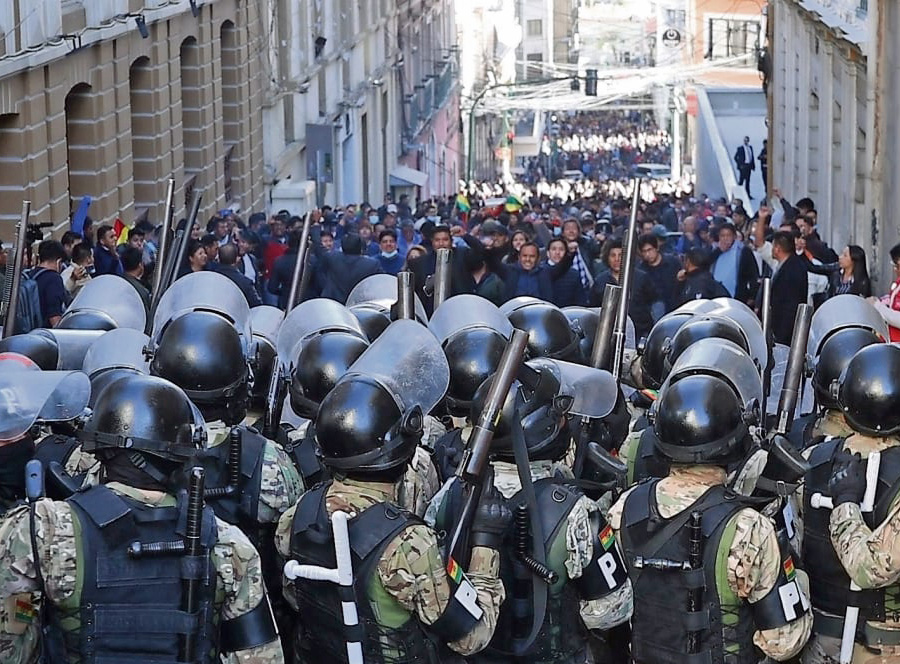 The
government’s hollow calls for dialogue, coupled with the crackdown on
protests (at least four protesters were killed), failed to stem the
movement: there were about a hundred roadblocks in early June, and the
president’s resignation—six months after his election—became a central
demand.
The
government’s hollow calls for dialogue, coupled with the crackdown on
protests (at least four protesters were killed), failed to stem the
movement: there were about a hundred roadblocks in early June, and the
president’s resignation—six months after his election—became a central
demand.
Rodrigo Paz, who took office as president in November 2025, was elected on a platform of “capitalism for all.” He capitalized on the rejection of the MAS (Movement Toward Socialism), which had been in power for twenty years (with the exception of the 2019 coup) and was mired in corruption scandals, divided between supporters and opponents of Evo Morales, and above all unable to cope with the most severe economic crisis the country had faced in decades: last year marked the first time the country entered a recession in 40 years (excluding the COVID year): inflation hovering around 20% (annually) and a 1.6% decline in GDP, which the IMF projects will reach 3.3% by 2026. For years, profits from the sale of raw materials, especially natural gas, fueled economic growth and ensured social stability through the redistribution of a portion of these revenues. But the decline in gas production has led to a sharp drop in these revenues (from over $6 billion in 2014 to $1.1 billion in 2024), plunging the country’s finances into the red and triggering the economic crisis.
Paz had promised to restore order without resorting to the drastic austerity measures demanded by hard-line right-wingers, and while sparing the working class.
But once elected, his campaign promises vanished; the new government—which includes far-right elements (such as the police commander responsible for massacres during the 2019 coup) and enjoys the support of the United States and Milei’s Argentina—inevitably placed itself at the open service of big capital; it inaugurated an antisocial austerity policy in line with IMF recommendations; fuel subsidies were eliminated, triggering a surge in inflation, without any improvement in the quality of imported gasoline (2), the tax on large fortunes was repealed, etc. Fulfilling a long-standing demand of large landowners, a law (1720) amended land rights to allow for land grabs by agribusiness.
But the enactment of this 1720 law in April triggered an unexpected reaction: powerful protests by peasant and indigenous organizations erupted to the point of forcing the government to partially repeal it after 24 days of mobilization. This retreat spurred the spread of the movement against the government’s austerity measures.
The movement is led by the COB (Bolivian Workers’ Confederation) and the peasant unions. But the COB is not a class union, and it seeks to prevent the movement from becoming more radical. Although a union assembly voted on May 1 in favor of a general strike, the COB refused to implement this decision; it prefers to organize large demonstrations “for democracy” and the defense of the homeland, and to support the demand for the president’s resignation, that is, the holding of new elections. While so far the COB leadership has not dared to respond positively to Paz’s offers of dialogue—in several parts of the country, demonstrators have bypassed the trade unions, accusing them of trying to slow down the struggle—it is clear that they are looking for a way to end the conflict in the least disruptive manner for the established order. If they fail, the government is preparing to use force: it has passed a law authorizing the use of the military.
For the proletariat and the poor masses, democracy is nothing but a sham. The capitalist crisis means an intensification of anti-social and anti-worker attacks, regardless of which government is in power. Against these attacks, only a determined struggle, guided by clearly anti-capitalist principles, can be effective. This implies class struggle and independent class organization, for the exclusive defense of proletarian interests and not the interests of the “fatherland” or the “people”—that is, interests that are ultimately bourgeois; inter-classism always means the sacrifice of proletarian interests. The proletariat has the potential to bring bourgeois power to its knees, provided it fights on class positions and with class methods; it can then draw the rebellious petty-bourgeois and small-peasant strata into the struggle behind it, rather than being drowned in a paralyzing “popular” mass. It is this perspective that it must follow, contrary to what is advocated by the various far-left groups that support «popular democracy» and follow the COB.
For an independent class struggle of the proletariat!
For the rebuilding of the international class party!
For the international communist revolution!
(1) Evo Morales sought refuge in this region to avoid a court sentence.
(2) To save money, the government imports low-grade gasoline, which is cheaper but causes engine carbon buildup.
June 6, 2026
International Communist Party
Il comunista - le prolétaire - el proletario - proletarian - programme communiste - el programa comunista - Communist Program
www.pcint.org
Top

